
Structural Steel Fabrication Cost Per Ton: How to Estimate It Right (Using the Steel Weight Calculation Formula)
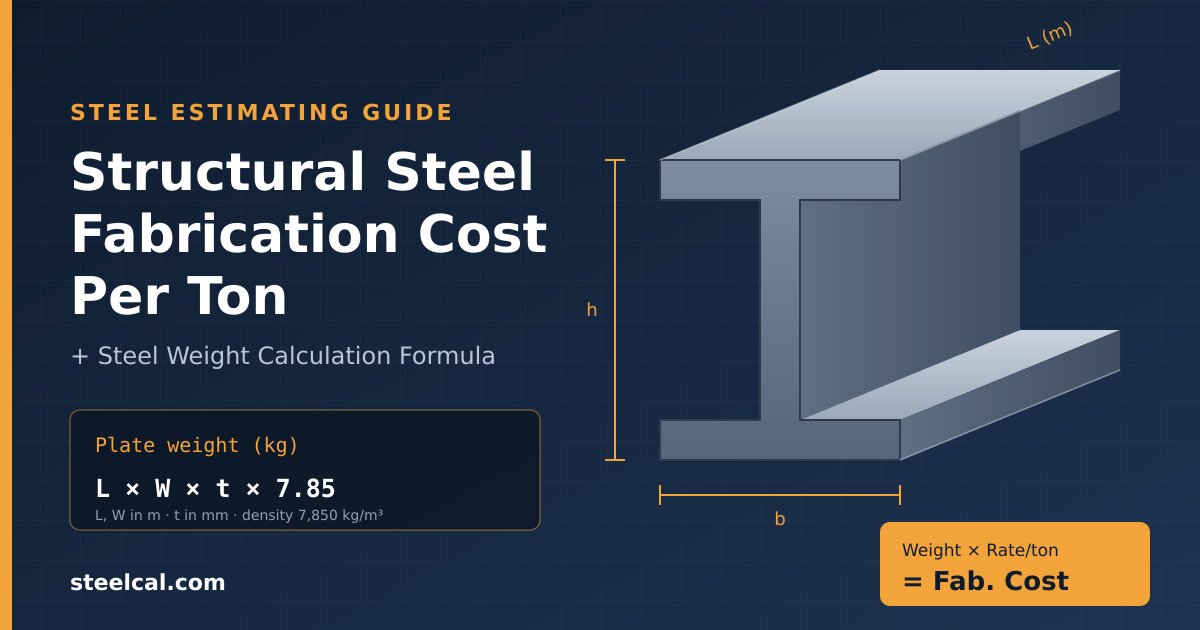
A contractor sends three fabricators the same mezzanine drawings. The quotes come back at 38 tons, 41 tons and 46 tons. Same drawings, same grade, an 8-ton spread before anyone even talks about price.
That spread is where most steel budgets go wrong. Fabrication is priced per ton, so whoever controls the weight takeoff controls the cost. If you can calculate weight yourself, you can check every quote line by line.
This guide shows how structural steel fabrication cost per ton is built up, how to run the steel weight calculation formula for every common section, and where buyers quietly lose money.
What does structural steel fabrication cost per ton include?
A “per ton” price is not one number. It bundles several cost layers, and fabricators rarely itemise them unless you ask.
- Raw material – beams, columns, plates, pipes and angles at mill or stockist price
- Shop fabrication – cutting, drilling, fitting, welding and quality checks
- Connections – cleats, end plates, stiffeners, gussets and bolts
- Surface treatment – blasting, primer, paint system or hot-dip galvanizing
- Delivery and erection – trucking, cranes, labour and site bolting
Always ask whether a quote is supply only, fabricated ex-works or fabricated and erected. Comparing those three as if they were the same is the most common bid-levelling mistake.
Sample cost-per-ton build-up
The table below uses assumed rates for a simple 40-ton industrial mezzanine. Treat the numbers as a working template, not a market quote; replace them with your own supplier and shop rates.
| Cost layer | Assumed rate (USD/ton) | 40 tons (USD) |
|---|---|---|
| Material (S275/S355 sections and plate) | 1,000 | 40,000 |
| Shop fabrication (cut, drill, weld) | 1,100 | 44,000 |
| Blast and paint system | 250 | 10,000 |
| Delivery and erection | 800 | 32,000 |
| Total, fabricated and erected | 3,150 | 126,000 |
Notice that material is less than a third of the erected cost. Labour-heavy layers move the total far more than the steel price does.
Why the weight takeoff drives every quote
Every layer in that table is multiplied by tonnage. An extra 3 tons in the takeoff adds roughly USD 9,450 at the rate above, without a single extra beam on site.
Weight errors creep in three ways:
- Using rounded or wrong kg/m values for sections
- Forgetting or double-counting connection steel
- Pricing plates by gross sheet weight instead of the parts actually used
The fix is simple: run your own takeoff with the correct formulas, then compare it with each fabricator’s figure.
The steel weight calculation formula (the one rule behind all of them)
Every steel weight formula comes from one line: weight equals volume times density. Carbon steel density is 7,850 kg/m³.
Weight (kg) = Volume (m³) × 7,850
In practice, engineers rearrange it into shortcuts per shape. The table gives the ones used on almost every job.
| Section | Formula | Units |
|---|---|---|
| MS plate / sheet | L × W × t × 7.85 | L, W in m; t in mm; result kg |
| Round bar | d² ÷ 162 | d in mm; result kg/m |
| Square bar | a² × 0.00785 | a in mm; result kg/m |
| Pipe / round tube | (OD − t) × t × 0.02466 | mm; result kg/m |
| Equal angle (approx.) | (2b − t) × t × 0.00785 | mm; result kg/m |
| Beams, columns, channels | Use the standard kg/m from the section table | kg/m × length |
For rolled beams and channels, never derive weight from flange and web sizes. Root radii make hand calculations inaccurate; use the published mass per metre instead.
How to calculate MS plate weight: worked example
A standard sheet of 2,440 × 1,220 mm at 10 mm thick:
- Convert length and width to metres: 2.44 m × 1.22 m = 2.977 m²
- Multiply by thickness in mm: 2.977 × 10 = 29.77
- Multiply by 7.85: 29.77 × 7.85 = 233.7 kg per sheet
Ten sheets weigh about 2.34 tons. That is the figure your plate supplier should invoice against, give or take mill tolerance.
Pipe and round bar examples
- Pipe 114.3 mm OD × 6.0 mm wall: (114.3 − 6) × 6 × 0.02466 = 16.0 kg/m. A 6 m length weighs 96 kg.
- Round bar 20 mm: 20² ÷ 162 = 2.47 kg/m. A 12 m bar weighs 29.6 kg.
- Equal angle 50 × 50 × 5 mm: (100 − 5) × 5 × 0.00785 = 3.73 kg/m, within about 1% of the table value of 3.77.
Skip the manual math: Use our free Steel Cost & Weight Estimator to list plates, pipes, beams and bars together and get the total tonnage instantly.
H beam and UC beam weight per meter: quick reference
Beams and columns usually make up the bulk of a frame’s tonnage. These are standard nominal masses for the sections buyers ask about most.
| Section | Mass (kg/m) | 12 m length (kg) |
|---|---|---|
| IPE 200 | 22.4 | 269 |
| IPE 300 | 42.2 | 506 |
| HEA 200 | 42.3 | 508 |
| UC 203 × 203 × 46 | 46.1 | 553 |
| HEB 200 | 61.3 | 736 |
| UC 254 × 254 × 73 | 73.1 | 877 |
| UC 305 × 305 × 97 | 96.9 | 1,163 |
| HEB 300 | 117.0 | 1,404 |
Worked takeoff: 20 columns of UC 254 × 254 × 73 at 12 m each = 20 × 12 × 73.1 = 17,544 kg, or 17.54 tons. At the sample rate of USD 3,150/ton, that line alone is about USD 55,250 erected.
What pushes cost per ton up (or down)?
Two jobs with the same tonnage can differ by 40% or more in fabrication cost. The difference is labour hours per ton, not steel.
| Factor | Lowers cost per ton | Raises cost per ton |
|---|---|---|
| Member size | Heavy, repetitive columns and beams | Light sections with many small parts |
| Connections | Standard bolted end plates | Full-penetration welds, moment connections |
| Repetition | Same beam size across bays | Every piece unique |
| Surface treatment | Primer only, internal use | Multi-coat marine system or galvanizing |
| Tolerances | Standard shop tolerances | Tight architectural or exposed steel finish |
| Site access | Open site, single crane | Congested site, night work, tower cranes |
This is why light steel often looks cheap per kilogram but expensive per ton. A 6-ton canopy full of small brackets can cost more to fabricate than a 15-ton portal frame.
Don’t forget the connection allowance
Main-member takeoffs miss plates, cleats, stiffeners and bolts. Most estimators add 8–15% of main-member weight for connections, depending on how complex the joints are.
In the mezzanine example, the main members came to 36.4 tons. Adding 10% for connections brought the priced weight to 40 tons. Check which allowance each fabricator used before comparing quotes.
How plate nesting cuts material wastage
Plates are bought by the sheet but used as parts. Every offcut you can’t use is paid for at full price, then sold back as scrap at a fraction of it.
Take a 2,500 × 1,250 × 12 mm plate. It weighs 2.5 × 1.25 × 12 × 7.85 = 294.4 kg.
- Base plates 400 × 400 mm: 6 across × 3 down = 18 pieces. Used area 2.88 m² of 3.125 m², a 92% yield.
- Base plates 450 × 450 mm: 5 across × 2 down = 10 pieces. Used area 2.03 m², only a 65% yield.
A 50 mm change in part size threw away more than a quarter of the plate. Where the design allows, ask the engineer whether parts can be sized to nest efficiently in standard sheets.
Plan your cuts before you buy: Enter your part sizes and sheet size in the free Plate Cutting & Nesting Optimizer to see yield, sheet count and offcut weight.
Procurement tips that save real money
These come from years of watching good jobs lose margin on details.
- Clarify theoretical vs actual weight. Mill sections are rolled to a mass tolerance, so weighbridge weight can differ from the table by a few percent. Agree in the PO which one you’re paying for.
- Order lengths that suit the cut list. Buying 12 m stock for 5.5 m members leaves 1 m of offcut per bar. Ask about 6 m or cut-to-length supply instead.
- Consolidate sizes. Rationalising five similar beam sizes into two improves buying power and repetition in the shop.
- Check grade substitution. S355 at a slight premium can sometimes allow lighter sections than S275, reducing total tonnage.
- Get mill test certificates with delivery. Rejected steel on site costs far more than the paperwork.
- Lock price validity. Steel prices move; a quote valid for 7 days won’t hold for a 6-week approval cycle.
Ready to price your list? Send your takeoff to our supply team through the Steel Quotation (RFQ) form and get a formal quote for beams, plates, pipes and angles.
Structural Steel Fabrication Cost Per Ton & Steel Weight Calculation Formula (UAE Guide)
Quick answer: Structural steel is priced on weight, so every fabrication quote starts with tonnage. A UAE fabrication price is built from four blocks: material tonnage + fabrication + surface protection + delivery and erection support. Get the weight right with the formulas below, then ask your fabricator to price each block separately.
Why “cost per ton” is the wrong first question
“What’s your rate per ton?” is the first question on most steel enquiries. But two quotes at the same rate per ton can end up thousands of dirhams apart, because the tonnage underneath them is different. One supplier may use theoretical section weights, another may add cutting allowance, and a third may price painting or galvanizing inside the rate. Compare the tonnage first, then the rates.
Steel weight calculation formulas
Steel has a density of 7,850 kg/m³. That gives the factor 7.85 used in most shop formulas.
1. Steel plate (MS plate, chequered plate, GI sheet)
Weight (kg) = Length (m) × Width (m) × Thickness (mm) × 7.85
Example: a 6 × 1.5 m plate, 10 mm thick → 6 × 1.5 × 10 × 7.85 = 706.5 kg.
Shortcut: 1 m² of plate weighs thickness × 7.85 kg. So 6 mm plate is 47.1 kg/m² and 10 mm is 78.5 kg/m².
2. Beams, channels and angles (H/I beams, UC, UPN, angles)
Weight (kg) = kg per metre (from the section table) × total length (m)
Example: 20 pieces of HEA 200 at 6 m each. HEA 200 weighs 42.3 kg/m → 20 × 6 × 42.3 = 5,076 kg (about 5.08 tons).
3. Round pipe (MS and GI pipe)
Weight (kg/m) = (Outside diameter (mm) − Wall thickness (mm)) × Wall thickness (mm) × 0.02466
Multiply by the length in metres for the total.
4. Square and rectangular hollow sections (SHS / RHS)
Weight (kg/m) ≈ (2 × (Width + Height) − 4 × Thickness) × Thickness × 0.00785 (all in mm)
This ignores the rounded corners, so it reads slightly high, which is the safe side for estimating.
5. Round bar
Weight (kg/m) = Diameter (mm)² × 0.00617
Don’t want to do it by hand? Use the free Steelcal metal weight calculator for plates, beams, pipes, tubes and bars, and the steel size & weight chart for section tables.
How a steel fabrication price per ton is built
1. Material tonnage
The steel itself, priced on weight. Prices move with size, thickness and stock availability, so always ask for a current price. Check whether the quote uses theoretical weight from section tables or actual weighbridge weight, and whether cutting allowance is included.
2. Fabrication
Cutting, drilling, fitting and welding. This is where “per ton” rates differ most, because the work depends on complexity, not weight. A simple mezzanine with bolted connections takes far fewer hours per ton than a portal frame with haunches, stiffeners and moment connections. More connections, more welding and more cutting mean a higher rate.
3. Surface protection
Shot blasting, primer and paint, or hot-dip galvanizing. Galvanizing is usually priced on weight too, so the tonnage figure matters here again.
4. Delivery and erection support
Transport to site, match-marking and erection support. Long members and site access (cranes, permits, working hours) affect this block.
5 checks before you compare fabrication quotes
- Ask for the price split into the four blocks above.
- Confirm the total tonnage and whether it is theoretical or actual weight.
- Check the steel grade (for example S275 or S355) and that mill test certificates are included.
- Check the paint system or galvanizing specification.
- Confirm what is excluded: erection, cranes, anchor bolts, site welding, NDT.
Get a fabrication quote in the UAE
Steelcal (Ibnee Younus Building & Construction Materials Trading Co. LLC, Dubai Industrial City) supplies structural steel and fabricates mezzanines, sheds, portal frames, platforms and miscellaneous steelwork, with in-house CNC laser cutting. See our steel fabrication services or try the steel cost estimator.
Send your drawings or BOQ on WhatsApp: +971 58 566 7721 — open 8 AM to 7 PM, every day.
Frequently asked questions
How much does structural steel fabrication cost per ton?
It depends on scope. Supply-only prices cover material, while fabricated and erected prices add shop labour, coatings, transport and installation. Erected rates are typically several times the raw steel price. Complexity, connection type and coating system matter more than steel price, so always compare quotes on the same scope.
What is the formula to calculate steel weight?
Weight equals volume multiplied by steel density of 7,850 kg/m³. For plates, use length (m) × width (m) × thickness (mm) × 7.85 to get kilograms. Round bars use d² ÷ 162 in kg/m. For beams and channels, multiply the published kg/m value by the length.
How do I calculate MS plate weight quickly?
Multiply length and width in metres by thickness in millimetres, then by 7.85. A 2.44 × 1.22 m plate at 10 mm thick gives 2.977 × 10 × 7.85, which is about 233.7 kg. Use the same method for any plate size or thickness of carbon steel.
Why do fabricators’ tonnage figures differ for the same drawings?
Differences usually come from connection allowances, rounding of section weights, gross versus net plate weights and missed or duplicated members. One fabricator may add 8% for connections, another 15%. Running your own takeoff lets you level bids and question any figure that looks inflated.
How can I reduce steel fabrication costs?
Standardise section sizes, prefer bolted connections over site welding, and repeat member types across bays. Size plate parts to nest efficiently in standard sheets, order stock lengths that suit the cut list, and fix the coating system early. Small design changes often cut labour hours per ton significantly.

Comments are closed.